


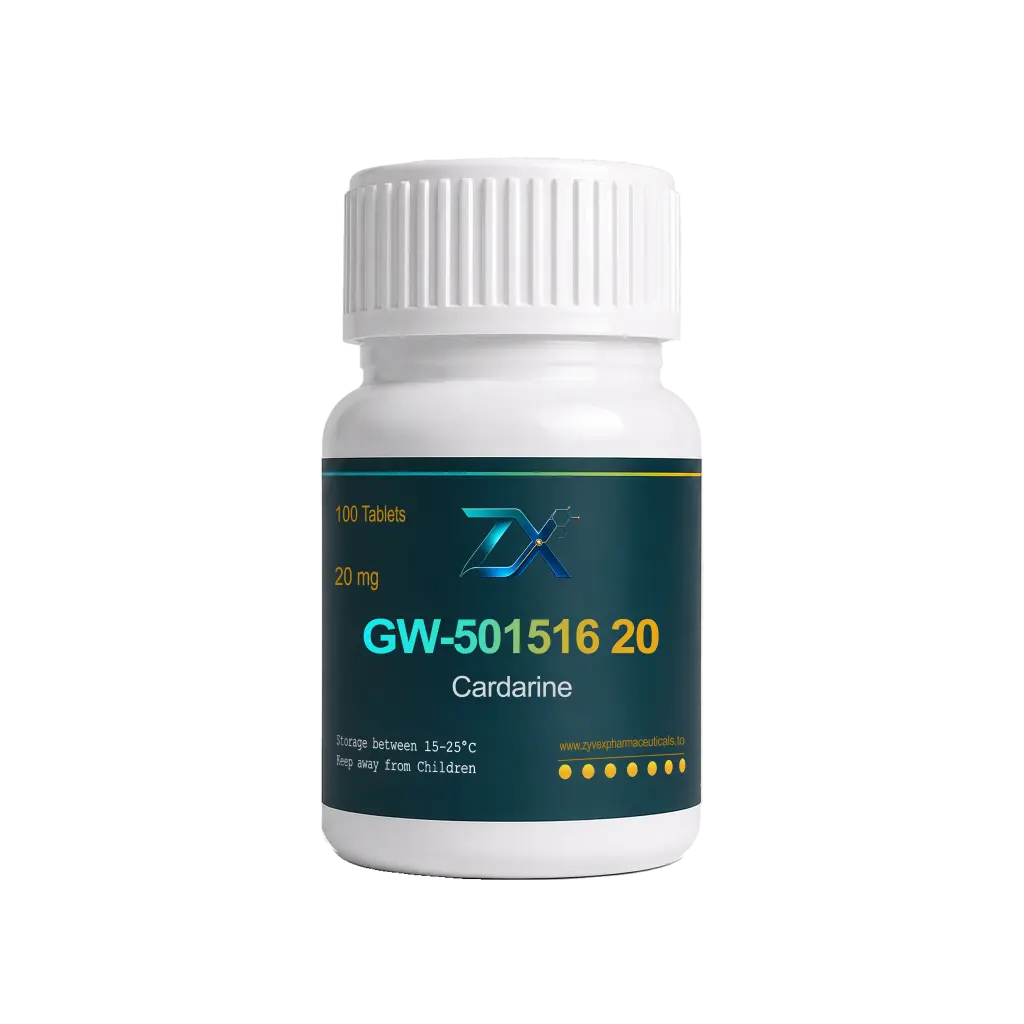
Fabricator: Zyvex Pharmaceuticals
Unit: x1 1 ml
Strength: 20 mg/tab
If your order hasn’t arrived within 35 days after shipping, we’ll resend it for free.
Cardarine is not a SARM and not a steroid. It is a PPAR-delta agonist, and the receptor it activates decides which fuel muscle burns: more fatty acid oxidation, less reliance on glucose, and a measurable change in endurance capacity in animal models long before anyone put it in a bodybuilding catalogue.
Zyvex supplies GW-501516 as a tablet in a foil blister, batch coded on the box. Nothing here touches the androgen axis, which is why it can be run alongside anything and stopped without a recovery protocol.
PPAR-delta is one of the three peroxisome proliferator activated receptors, and its job is to shift skeletal muscle toward fat oxidation and away from glycolysis. Activation increases fatty acid transport into mitochondria, raises the proportion of slow-twitch behaviour in trained muscle, and improves the capacity to sustain work.
The half-life is sixteen to twenty-four hours, so once-daily dosing is enough. Because the mechanism is metabolic rather than hormonal, there is no suppression, no oestrogen, no prolactin and no PCT. The compound is on every anti-doping list for the same reason it is popular: the endurance effect is real.
The active ingredient is GW-501516 at the per-tablet strength printed on the Zyvex blister, with standard binders, filler, disintegrant and lubricant. The excipient panel is on the box. No stimulant, no thyroid hormone and no androgen is included.
Once a day with food; absorption improves slightly with a meal. Many users time it thirty to sixty minutes before cardio, which is habit rather than pharmacology, since the half-life covers a full day. An eight to twelve week block is typical.
Do not expect it to outrun a bad diet. Cardarine changes the fuel mix, not the calorie balance, and running it in a surplus will simply make you fitter at the same weight.
Reported ranges, not a prescription:
Human reports are unremarkable: headaches, the odd bout of nausea, and joints that complain at the top of the dose range. Nothing hormonal, and nothing like the stimulant jolt of a thermogenic.
The serious concern comes from animal work, where high doses over most of a rodent's life produced cancers in several organs and the compound was abandoned commercially. Eight weeks at 10 to 20 mg is a very different exposure from two years at a high dose in a rodent, and nobody can honestly say which way that cuts. A personal history of cancer should rule it out.
No hormonal bloodwork is required because nothing is suppressed, though a lipid panel at week eight is sensible on a longer block. Avoid stacking it with another PPAR agonist, and do not run it continuously for a year on the strength of forum reports.
Not for under-21s, anyone with a current or past cancer diagnosis, or anyone pregnant or nursing. Store at room temperature, dry and out of light, in the sealed blister. Sold for research use, and the laboratory testing for this range is pending rather than published.
Please log in to write Cardarine (GW-501516) review.

Fabricator: Dragon Pharma, Europe
Unit: x1 100 tabs
Strength: 20 mg/tab
If your order hasn’t arrived within 35 days after shipping, we’ll resend it for free.

Fabricator: Dragon Pharma, Europe
Unit: x1 100 tabs
Strength: 25 mg/tab
If your order hasn’t arrived within 35 days after shipping, we’ll resend it for free.

Fabricator: Dragon Pharma, Europe
Unit: x1 100 tabs
Strength: 10 mg/tab
If your order hasn’t arrived within 35 days after shipping, we’ll resend it for free.

Fabricator: Dragon Pharma, Europe
Unit: x1 100 tabs
Strength: 500 mcg/tab
If your order hasn’t arrived within 35 days after shipping, we’ll resend it for free.

Fabricator: Dragon Pharma, Europe
Unit: x1 100 tabs
Strength: 15 mg
If your order hasn’t arrived within 35 days after shipping, we’ll resend it for free.

Fabricator: Dragon Pharma, Europe
Unit: x1 100 tabs
Strength: 25 mg/tab
If your order hasn’t arrived within 35 days after shipping, we’ll resend it for free.

Fabricator: Dragon Pharma, Europe
Unit: x1 100 tabs
Strength: 25 mg/tab
If your order hasn’t arrived within 35 days after shipping, we’ll resend it for free.

Fabricator: Dragon Pharma, Europe
Unit: x1 100 tabs
Strength: 10 mg/tab
If your order hasn’t arrived within 35 days after shipping, we’ll resend it for free.
No, though every shop files it with them. It is a PPAR-delta agonist, which is a metabolic receptor rather than an androgen receptor, and the side effect profile follows from that.
Usually within a fortnight, and it is the first thing anyone notices. Visible body composition moves much later and only if a deficit is doing the work.
The androgen axis is not involved at any point, so there is nothing to recover afterwards and no PCT to run. That is also why it stacks with anything.
It is the reason the compound was abandoned commercially: tumours across several organs at high doses over most of an animal's life. What that means for eight weeks at 10 to 20 mg in a human is genuinely unknown.
You can, but the logic is thin: one raises metabolic rate through stimulants, the other shifts fuel use. Stacking them adds cardiac load without adding much.