


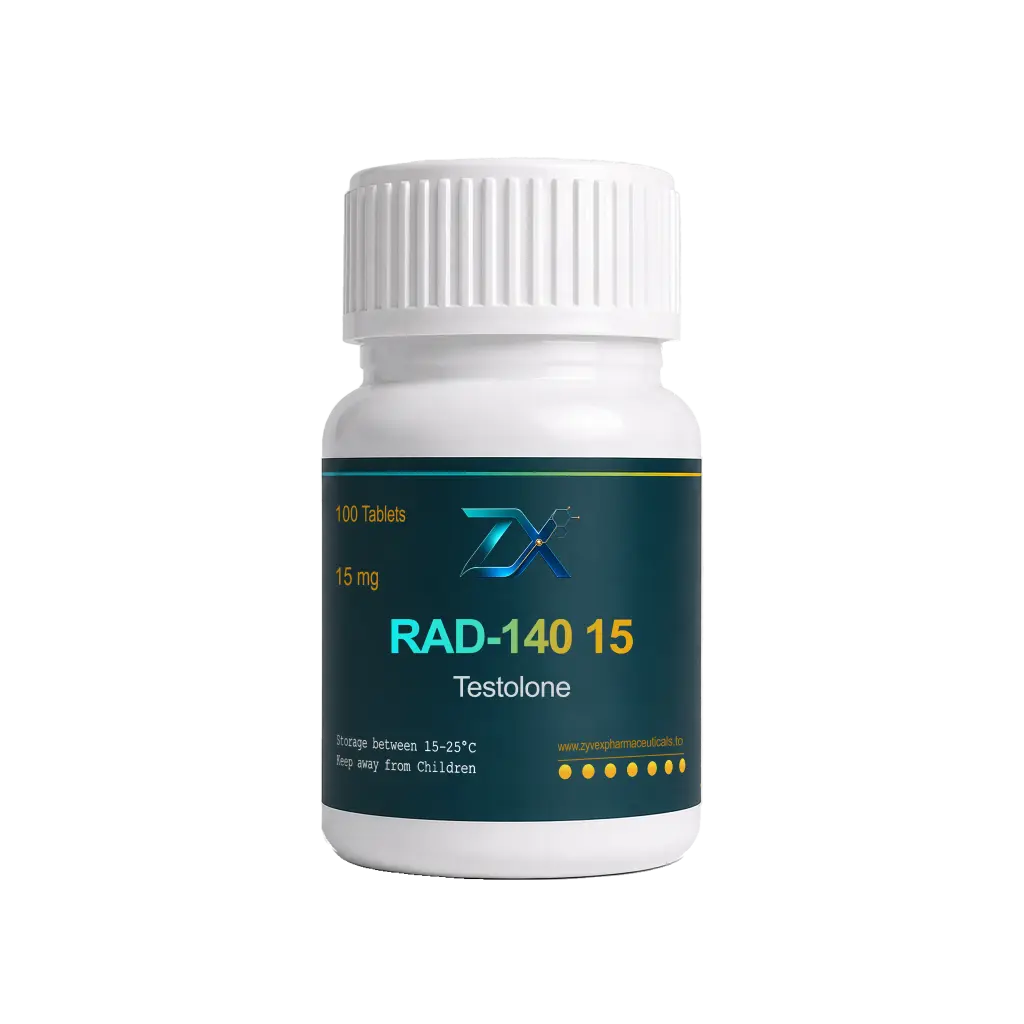
Fabricator: Zyvex Pharmaceuticals
Unit: x1 100 tabs
Strength: 15 mg/tab
If your order hasn’t arrived within 35 days after shipping, we’ll resend it for free.
Testolone, better known as RAD 140, is the SARM that gets compared to a steroid most often, and the comparison is fairer on strength than on size. Zyvex supplies it as an oral tablet in a sealed blister, dosed once a day. It is neither a steroid nor a methylated compound, and it does not convert to oestrogen, which changes the side effect list and changes what happens when the run ends.
The selectivity that gives SARMs their name is relative rather than absolute: at bodybuilding doses, natural testosterone production is suppressed. That single fact is what separates a sensible eight-week run from three months of feeling flat.
RAD 140 binds the androgen receptor with high affinity and shows tissue selectivity in research models, favouring muscle and bone over prostate and skin relative to testosterone. It is not a substrate for aromatase and not a substrate for 5-alpha reductase, so there is no oestradiol and no DHT to manage downstream.
The elimination half-life sits around twenty hours, which is why once-daily dosing is enough. Because it is not 17-alpha alkylated, it does not carry the liver burden of an oral steroid, but it does suppress the hypothalamic axis: LH falls, total and free testosterone follow, and the recovery period is proportional to the dose and the length of the run.
The active ingredient is RAD 140 at the per-tablet strength printed on the Zyvex blister. The tablet base uses standard binders, filler, disintegrant and lubricant, and the complete excipient panel is on the box. No stimulant, no aromatase inhibitor and no testosterone is included.
Take one tablet a day at a consistent time, with or without food. Because the half-life is close to a full day, the clock matters more than the meal. Most users run it for eight weeks and take bloodwork at week four rather than waiting for the end.
If lethargy appears in the final fortnight, that is usually suppression rather than the product failing, and the answer is to finish the run and start recovery rather than to increase the dose.
Reported ranges, not a prescription:
Suppression is the main event: LH and total testosterone fall, and at 20 mg and above the drop is enough to leave you flat for weeks after stopping. Lethargy, sleep disruption and headache are reported at the higher end.
No methylation means hepatic stress is not the headline risk the way it is for an oral steroid, but some users see lipids drift and blood pressure is worth measuring rather than guessing at. Gynaecomastia is not a RAD 140 effect.
Bloodwork at baseline, at week four and four weeks after the last tablet: total testosterone, LH, lipids and a liver panel cover what matters. If testosterone has not recovered by the four-week mark, a SERM course is the usual next step rather than a second SARM.
Not for under-21s, anyone with a history of hormone-sensitive cancer, or anyone pregnant or nursing. Store at room temperature, dry and out of light, in the sealed blister. Sold for research use, and the laboratory testing for this range is pending rather than published.
Please log in to write Testolone (RAD 140) review.

Fabricator: Dragon Pharma, Europe
Unit: x1 100 tabs
Strength: 25 mg/tab
If your order hasn’t arrived within 35 days after shipping, we’ll resend it for free.

Fabricator: Dragon Pharma, Europe
Unit: x1 100 tabs
Strength: 10 mg/tab
If your order hasn’t arrived within 35 days after shipping, we’ll resend it for free.

Fabricator: Dragon Pharma, Europe
Unit: x1 100 tabs
Strength: 500 mcg/tab
If your order hasn’t arrived within 35 days after shipping, we’ll resend it for free.

Fabricator: Dragon Pharma, Europe
Unit: x1 100 tabs
Strength: 20 mg/tab
If your order hasn’t arrived within 35 days after shipping, we’ll resend it for free.

Fabricator: Dragon Pharma, Europe
Unit: x1 100 tabs
Strength: 15 mg
If your order hasn’t arrived within 35 days after shipping, we’ll resend it for free.

Fabricator: Dragon Pharma, Europe
Unit: x1 100 tabs
Strength: 25 mg/tab
If your order hasn’t arrived within 35 days after shipping, we’ll resend it for free.

Fabricator: Dragon Pharma, Europe
Unit: x1 100 tabs
Strength: 25 mg/tab
If your order hasn’t arrived within 35 days after shipping, we’ll resend it for free.

Fabricator: Dragon Pharma, Europe
Unit: x1 100 tabs
Strength: 10 mg/tab
If your order hasn’t arrived within 35 days after shipping, we’ll resend it for free.
It does not. Testolone is a selective androgen receptor modulator: no aromatisation and no 17-alpha methylation. What it still does is suppress your own testosterone production.
Ten milligrams a day for a first run, fifteen to twenty for a standard one. Above twenty the suppression climbs faster than the strength does.
At 10 mg and above, for eight weeks, expect to need one. LH falls first and total testosterone follows it, so a four-week SERM course with bloodwork afterwards is the sensible close rather than a wait-and-see.
Because nothing happens in week one. Strength moves in weeks three to five, which is consistent with receptor-mediated growth rather than a hormonal spike.
That combination is popular and makes sense: testolone covers strength and lean tissue while cardarine targets endurance through a completely separate receptor pathway, so the two do not compete.