


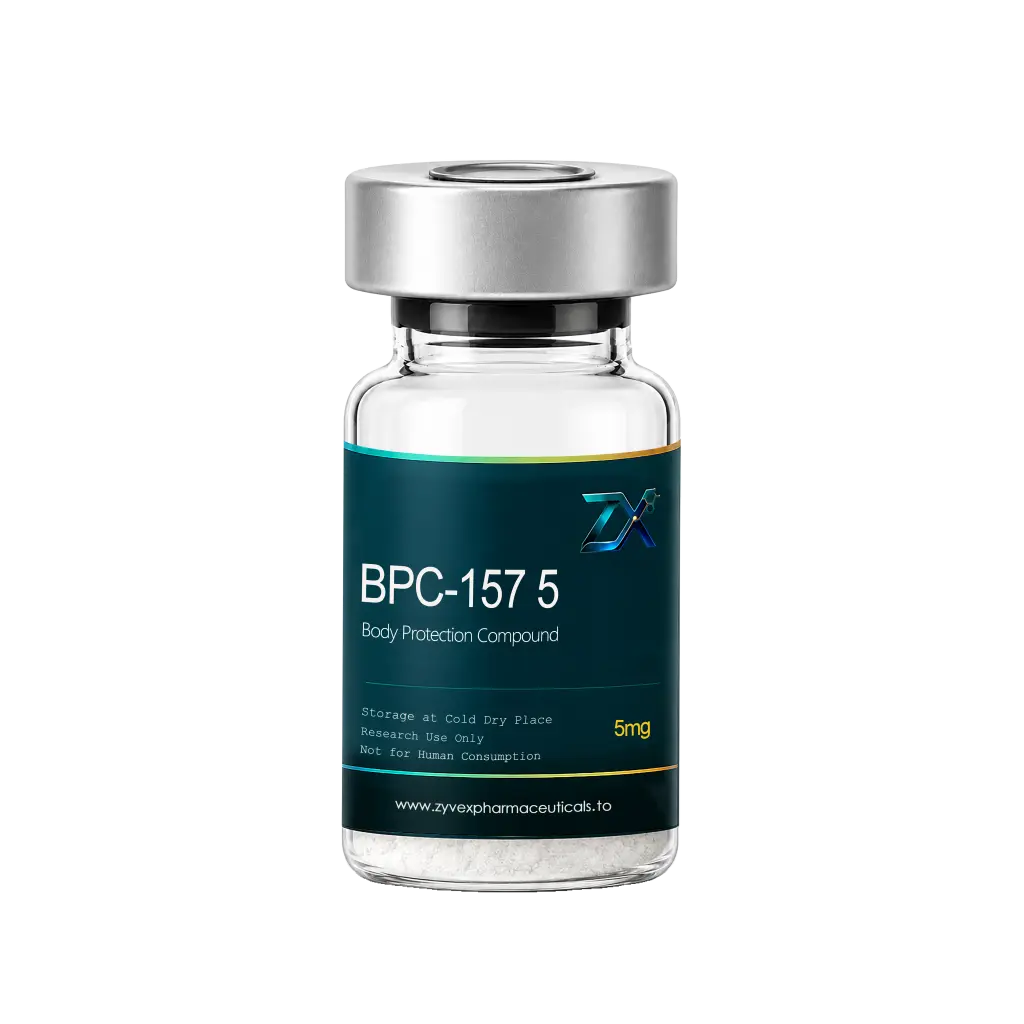
Fabricator: Zyvex Pharmaceuticals
Unit: x1 vial
Strength: 5 mg
If your order hasn’t arrived within 35 days after shipping, we’ll resend it for free.
BPC 157 is a fifteen-amino-acid fragment of a protein found in human gastric juice, and that origin explains the two things that make it unusual: it is stable in stomach acid, and its best-documented effects are in the gut and in connective tissue. It is what people try when a tendon has stopped responding to rest.
Zyvex supplies it lyophilised in a sealed vial, batch coded on the label. Nothing about it is hormonal: it is neither a steroid nor a SARM, and the androgen axis is untouched.
The peptide upregulates growth factor receptors and promotes angiogenesis, the formation of new blood vessels, which is why it appears in tendon, ligament, muscle and gut lining research. It also interacts with the nitric oxide system, which may explain some of the blood-flow effects reported.
Because it survives digestion, oral dosing is a genuine option rather than a compromise, which is unusual for a peptide. Subcutaneous use targets tissue near the injection site; oral use targets the gut and, to a lesser extent, the whole system.
The vial contains BPC 157 as a lyophilised powder with buffer salts, with no preservative until reconstitution. The exact content per vial is on the Zyvex label and determines the concentration once you add water.
Reconstitute down the wall of the vial and swirl gently. For a tendon, inject subcutaneously as near the site as is practical. For gut symptoms, swallow the same dose instead; the peptide survives the stomach, which is the whole reason oral dosing works.
Keep the dry vial cold and the mixed one refrigerated, and use it inside the labelled window. A solution that has gone cloudy or grown particles is finished.
Reported protocols, not a prescription:
Reported effects are minimal: occasional nausea, headache, site irritation. Human safety data is limited, as it is for most research peptides.
Since it encourages new vessel growth, an active cancer diagnosis or a strong family history rules it out. Do not use a vial that has been left warm for days or mixed with anything other than bacteriostatic water.
No hormonal bloodwork is required. Keep everything cold and clean, never share a vial, and treat any hot, spreading or painful injection site as a medical issue rather than a nuisance.
Not for under-21s, anyone with a current or past cancer diagnosis, or anyone pregnant or nursing. Sold for research use only, and the laboratory testing for this range is pending rather than published.
Please log in to write BPC 157 review.

Fabricator: Stealth Labs
Unit: x1 vial
Strength: 10 mg/vial
If your order hasn’t arrived within 35 days after shipping, we’ll resend it for free.

Fabricator: Kalpa Pharmaceuticals LTD, India
Unit: x1 2 ml
Strength: 5 mg
If your order hasn’t arrived within 35 days after shipping, we’ll resend it for free.
Fabricator: Peptide Hubs
Unit: x1 vial
Strength: 5mg
If your order hasn’t arrived within 35 days after shipping, we’ll resend it for free.

Fabricator: Axiolabs
Unit: x1 vial
Strength: 5mg
If your order hasn’t arrived within 35 days after shipping, we’ll resend it for free.

Fabricator: British Dragon Pharmaceuticals
Unit: x1 vial
Strength: 5 mg
If your order hasn’t arrived within 35 days after shipping, we’ll resend it for free.

Fabricator: Dragon Pharma, Europe
Unit: x1 vial
Strength: 5mg
If your order hasn’t arrived within 35 days after shipping, we’ll resend it for free.

Fabricator: Stealth Labs
Unit: x1 vial
Strength: 10 mg/ml
If your order hasn’t arrived within 35 days after shipping, we’ll resend it for free.

Fabricator: Stealth Labs
Unit: x1 vial
Strength: 10 mg
If your order hasn’t arrived within 35 days after shipping, we’ll resend it for free.
Gut and connective tissue. The animal literature covers inflammatory bowel conditions, tendon and ligament healing, and ulcer models, which is why it is used for both gut symptoms and stubborn injuries.
Yes, and that is unusual for a peptide. It survives stomach acid, which is why oral dosing is a real option rather than a waste of product.
Subcutaneously as close to the site as the anatomy allows. For gut symptoms, oral is the route that makes sense.
Bacteriostatic water down the vial wall, then swirl. Five milligrams into 2 mL gives 2.5 mg per mL, so a 500 mcg dose is 0.2 mL.
It does not. There is no interaction with androgens, so it can run alongside a cycle or through recovery without altering either.