


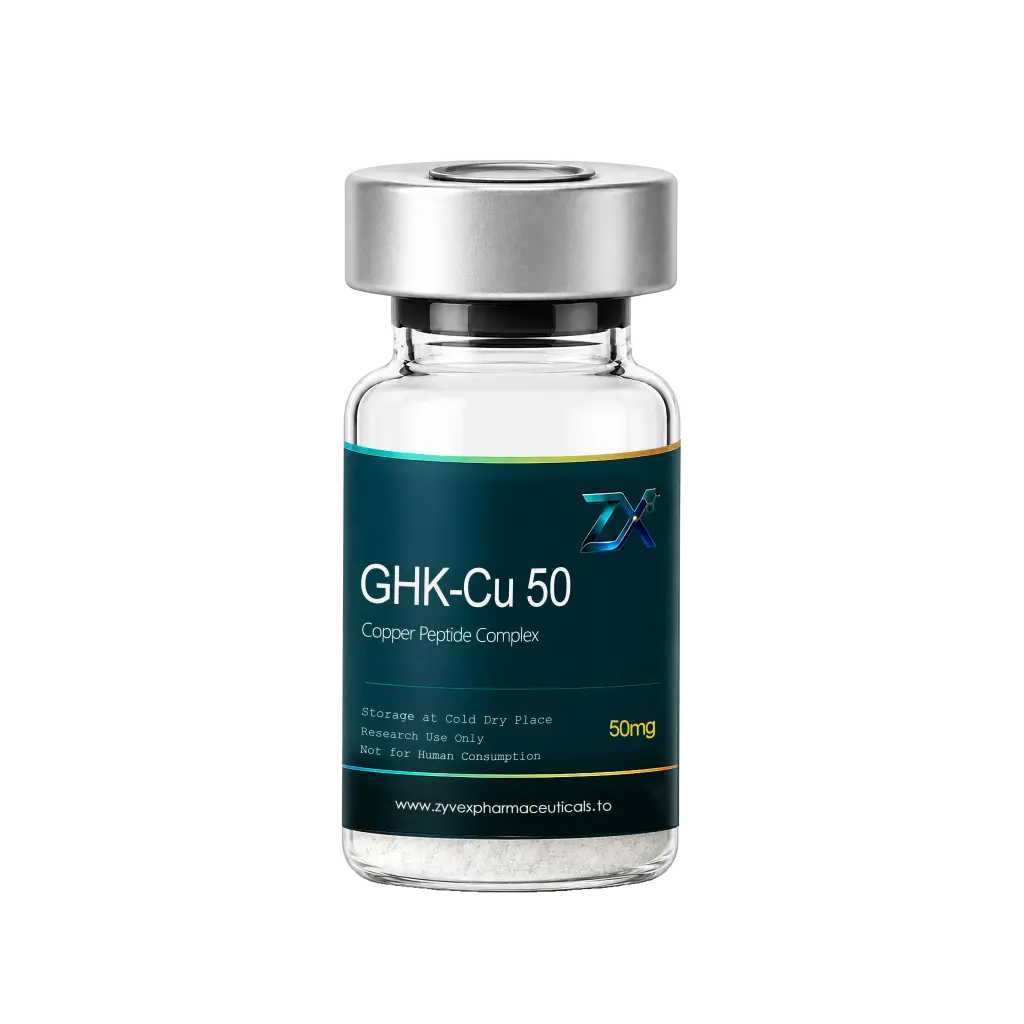
Fabricator: Zyvex Pharmaceuticals
Unit: x1 vial
Strength: 50 mg
If your order hasn’t arrived within 35 days after shipping, we’ll resend it for free.
GHK-CU is three amino acids holding a copper ion, and the copper is the point. The peptide occurs naturally in plasma and saliva, and its documented activity is in gene expression: it switches on collagen, elastin and glycosaminoglycan production, and it carries copper into the tissue where those processes need it.
Zyvex supplies it as a lyophilised vial, batch coded on the label. Reconstituted, it is a deep blue solution, which is the copper and not an impurity. It is not a steroid and has nothing to do with the androgen axis.
The tripeptide sequence binds copper with high affinity and delivers it to cells, where copper acts as a cofactor for lysyl oxidase and other enzymes involved in cross-linking collagen. That is the mechanism behind the skin, wound and hair research, and it explains why the effects are cumulative rather than dramatic.
GHK-CU is short-lived in plasma, so the effect is local and repeated rather than systemic and sustained. Applied topically, it works on the skin it touches. Injected, it reaches tissue through the circulation and the effect is broader but less concentrated.
The vial contains the GHK-CU tripeptide as a lyophilised powder with buffer salts. The copper is bound to the peptide rather than added separately, which is why the colour appears only after reconstitution. Full content per vial is printed on the Zyvex label.
For topical use, add the reconstituted solution to a neutral serum or cream and apply to clean skin, avoiding acids and vitamin C in the same routine since both destabilise the copper complex. For subcutaneous use, inject into the abdomen or thigh, rotating sites.
Swirl, do not shake. Keep the dry vial cold and the mixed one refrigerated, and use it within the labelled window. Anything cloudy, or a solution that loses its colour, should be discarded.
Reported protocols, not a prescription:
A sore injection site, a metallic taste in the mouth, and sometimes redness where it is applied. All three are local and uncommon.
Copper handling matters: a diagnosis of Wilson's disease, or any disorder of copper metabolism, rules it out. As with any research peptide, long-term human data is limited.
No hormonal bloodwork is needed. Keep the vial cold and out of light, never share a needle, and stop if a site becomes hot or spreading.
Not for under-21s, anyone with a copper metabolism disorder, or anyone pregnant or nursing. Sold for research use only, and the laboratory testing for this range is pending rather than published.
Please log in to write GHK-CU 50 review.

Fabricator: British Dragon Pharmaceuticals
Unit: x1 vial
Strength: 50 mg
If your order hasn’t arrived within 35 days after shipping, we’ll resend it for free.

Fabricator: Axiolabs
Unit: x1 vial
Strength: 50mg
If your order hasn’t arrived within 35 days after shipping, we’ll resend it for free.

Fabricator: Kalpa Pharmaceuticals LTD, India
Unit: x1 vial
Strength: 50mg
If your order hasn’t arrived within 35 days after shipping, we’ll resend it for free.

Fabricator: Dragon Pharma, Europe
Unit: x1 vial
Strength: 50mg
If your order hasn’t arrived within 35 days after shipping, we’ll resend it for free.

Fabricator: Stealth Labs
Unit: x1 vial
Strength: 10 mg/ml
If your order hasn’t arrived within 35 days after shipping, we’ll resend it for free.

Fabricator: Stealth Labs
Unit: x1 vial
Strength: 10 mg
If your order hasn’t arrived within 35 days after shipping, we’ll resend it for free.

Fabricator: Dragon Pharma, Europe
Unit: x1 vial
Strength: 10mg
If your order hasn’t arrived within 35 days after shipping, we’ll resend it for free.

Fabricator: Dragon Pharma, Europe
Unit: x1 vial
Strength: 5mg
If your order hasn’t arrived within 35 days after shipping, we’ll resend it for free.
It drives collagen, elastin and glycosaminoglycan production through gene expression, and it delivers the copper those processes need. Skin quality and wound repair are what the research covers.
The copper. It is bound to the peptide and only becomes visible once the powder is dissolved, so a blue vial is normal and a colourless one is not.
Yes, and the topical route is where most of the skin interest comes from. Mix it into a neutral carrier and keep acids and vitamin C out of the same routine.
Months, and modestly. Collagen turnover is slow, so four weeks is not a fair test of anything.