


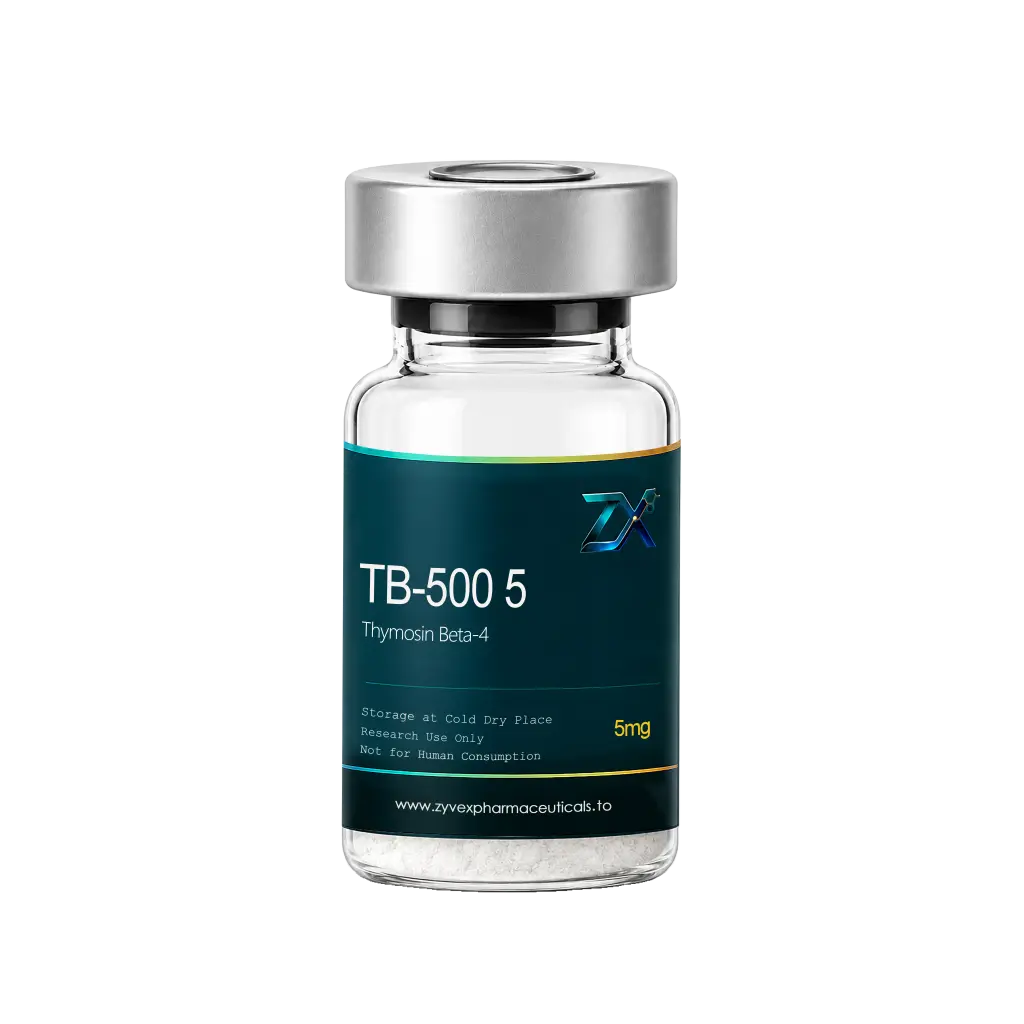
Fabricator: Zyvex Pharmaceuticals
Unit: x1 vial
Strength: 5 mg
If your order hasn’t arrived within 35 days after shipping, we’ll resend it for free.
TB 500 is a fragment of a protein that exists in almost every cell in the body, and its job in the literature is cell migration: it regulates actin, the filament that lets a cell move toward a wound. That is the mechanism behind every claim made for it, from tendon repair to cardiac tissue research.
Zyvex supplies it lyophilised in a sealed vial, batch coded on the label. It is not a steroid, not a SARM, and it does not touch the androgen axis, so it belongs in the recovery discussion rather than the cycle discussion.
Thymosin beta 4 is a 43-amino-acid peptide; TB 500 is the synthetic fragment that carries the actin-binding region. By upregulating actin polymerisation it encourages cells to migrate into damaged tissue, which is why the research spans corneal healing, cardiac repair after infarction, and tendon and ligament models.
In the body the peptide is short-lived, so dosing is about keeping a level present rather than building one up. The protocols people use are loading then maintenance, and the effects reported are slow: weeks rather than days, and subtle rather than dramatic.
The vial contains the thymosin beta 4 fragment as a lyophilised powder, with no preservative in the dry state. Bacteriostatic water is added at reconstitution. The full specification, including peptide content per vial, is printed on the Zyvex label.
Add bacteriostatic water down the inside wall of the vial and swirl it gently. Shaking produces foam and shear, and both damage the chain. Keep the dry vial refrigerated, keep the mixed vial cold, and finish it inside the labelled window.
A load runs four to six weeks, injected subcutaneously as close to the damaged tissue as the site allows. Rotate if you are pinning the same area repeatedly.
Reported protocols, not a prescription:
Reported effects are mild: irritation at the injection site, occasional headache, a flushed feeling shortly after dosing. Human safety data is limited, as with most research peptides.
Because the peptide promotes cell migration and vessel formation, anyone with an active cancer or a strong family history should treat it as off limits. A cloudy vial, particles, or a change in colour means discard it rather than use it.
No hormonal bloodwork is required. Keep the vial cold, protect it from light, and never share a vial or a needle. If a site becomes hot, spreading or painful beyond a day, get it looked at rather than injecting again.
Not for under-21s, anyone with a current or past cancer diagnosis, or anyone pregnant or nursing. Supplied for research use only, and the laboratory testing for this range is pending rather than published.
Please log in to write TB 500 review.

Fabricator: British Dragon Pharmaceuticals
Unit: x1 vial
Strength: 5 mg
If your order hasn’t arrived within 35 days after shipping, we’ll resend it for free.
Fabricator: Peptide Hubs
Unit: x1 vial
Strength: 5 mg
If your order hasn’t arrived within 35 days after shipping, we’ll resend it for free.

Fabricator: Dragon Pharma, Europe
Unit: x1 vial
Strength: 5mg
If your order hasn’t arrived within 35 days after shipping, we’ll resend it for free.

Fabricator: Stealth Labs
Unit: x1 vial
Strength: 10 mg/ml
If your order hasn’t arrived within 35 days after shipping, we’ll resend it for free.

Fabricator: Axiolabs
Unit: x1 vial
Strength: 5mg
If your order hasn’t arrived within 35 days after shipping, we’ll resend it for free.

Fabricator: Kalpa Pharmaceuticals LTD, India
Unit: x1 vial
Strength: 5 mg
If your order hasn’t arrived within 35 days after shipping, we’ll resend it for free.

Fabricator: Stealth Labs
Unit: x1 vial
Strength: 10 mg/ml
If your order hasn’t arrived within 35 days after shipping, we’ll resend it for free.

Fabricator: Stealth Labs
Unit: x1 vial
Strength: 10 mg
If your order hasn’t arrived within 35 days after shipping, we’ll resend it for free.
Soft tissue: tendons, ligaments, and muscle strains that keep flaring because training never stops. It is a repair peptide, not an anabolic, and it does not build muscle.
Weeks, not days. Most protocols load for four to six weeks before judging anything, and the change is usually stiffness and range of motion rather than a dramatic difference.
Subcutaneously near the site is common where the injury is accessible, and intramuscular is used for deeper tissue. Rotate sites if you are dosing the same area repeatedly.
It does not need to be, but the pairing is common: TB 500 works broadly on connective tissue while BPC 157 is used more locally and for gut symptoms.
Refrigerate it while dry. Once mixed it stays cold and needs finishing inside the window on the label. Freezing ruins it and shaking damages the chain.